news / Ukraine

Ukrainian Summer School 2026: Building a Community of Young Legal Minds Committed to International Justice

Share:

17 Aug 2026

“Guide the court’s attention to what matters most,” advised and counseled trial advocacy expert Professor Judith Ritter of Widener University Delaware Law School, just the day before the culminating mock trials during the first week of Summer School “Legal Skills in Times of War”. This seemingly simple practical tip bears a bigger lesson in the context of educating the young Ukrainian lawyers.

With the Russian full-scale invasion entering its fifth year, keeping the attention of the courts and the international community to the injustice in Ukraine remains as important as ever. As highlighted by the European Council so far, a total of 21 packages of sanctions have been adopted by the European Union. What is more, cases were opened in international and national courts, and the Special Tribunal for the Crime of Aggression against Ukraine is no longer just a proposal but a reality since February of this year.

With that in mind, the promise of justice and accountability is a long-term process that needs a very complex and farsighted strategy. The CEELI Institute believes that international expertise, combined with practical training for the next generation of lawyers, provides some of the tools and blueprints needed for that work.

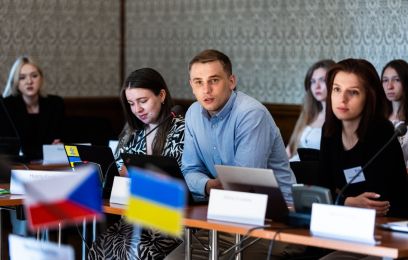
In mid-July, CEELI Institute hosted another 32 exceptional and very motivated Ukrainian law students and junior lawyers from various Ukrainian regions and universities. This fifth annual Ukrainian Summer School broke last year’s application record with 162 total submissions. The undiminished interest is a powerful reminder of the commitment of Ukrainian law students and early-career lawyers to strengthening their legal skills and their desire to find new solutions and skills to tackle the future.

The 2-week event took place at the historic Villa Grébovka in Prague, bringing together as faculty legal scholars, prosecutors, and human rights lawyers from around the world to train and mentor the next generation of legal advocates working towards achieving accountability in Ukraine.

Courtroom Skills

The first week of the program centered around trial advocacy and courtroom skills.

Lead faculty included John Vaudreuil, former United States Attorney for the Western District of Wisconsin; Marcia Levy, Associate Professor and Director of Field Placements & Pro Bono of the University of Maine School of Law; Judith Ritter, Widener University Delaware Law School; and Mariia Tsypiashchuk,  Partnership Fund for a Resilient Ukraine.

Students began by exploring the different approaches required when interviewing clients and witnesses. Alongside technical instruction, faculty encouraged them to develop confidence in their own voices as advocates. They also worked on curating closing arguments and on using effective storytelling to present a persuasive case in the courtroom.

Marika Somero, Debevoise & Plimpton’s London Office, took on the task of introducing the students to best practices of trauma-informed interviewing and legal practice. She highlighted the very important “Oxygen Mask Principle,” a lesson that can easily be overlooked by professionals who are focused on helping others: lawyers cannot effectively support traumatized clients if they themselves are depleted.

Learning by Doing

Through interactive lectures, daily group practice workshops, and even the dissection of legal motifs in movies, students prepared themselves to face their first court appearances, wrapping up the week with very intense yet immensely transformative Mock Trials.

Although some students had a chance to observe courtroom proceedings before, now they were in the middle of the action. Taking on the roles of prosecutors, defense counsel, and witnesses, they put their growing trial skills directly into practice. Throughout the simulations, experienced faculty observed the students’ performances in real time, highlighting the strongest parts of their approach and spotting areas for further improvement.

The students were surprised by how interactive and challenging the first week was, sharing that the program far exceeded any expectations they had before attending. Many were pointing to the interactive workshops as their favorite part, during which they could put into practice everything the faculty taught in the days before.

Understanding the Paths to Accountability

During the second week, the focus shifted from general courtroom advocacy to international criminal law, including the investigation and prosecution of war crimes, modes of liability, universal jurisdiction, and other possible avenues toward accountability.

Nobuo Hayashi, Associate Professor (Docent) and Senior Lecturer in the Department of International and Operational Law of the Swedish Defense University, tackled the extensive topic of modes of liability with our students.

During other sessions, Dmytro Koval, Associate Professor and Head of the International and European Law Department in the National University of Kyiv-Mohyla Academy, and the Co-Executive Director of Truth Hounds, drew on his first-hand experience to explain how the process of documenting war crimes actually worked in Ukraine.

The topic of defining crimes of aggression was discussed by Gaiane Nuridzhanian, Associate Professor of the Faculty of Law at UiT the Arctic University of Norway, and Head of the Research Group for Human Rights and International Law. Gabrielė Chlevickaitė, Senior Researcher at the Asser Institute and research fellow at the University of Amsterdam, detailed how crimes against humanity and genocide work. What is more, Sondre Torp Helmersen, Professor at the Faculty of Law at the UiT the Arctic University of Norway, explained the use and threat of force under international law.

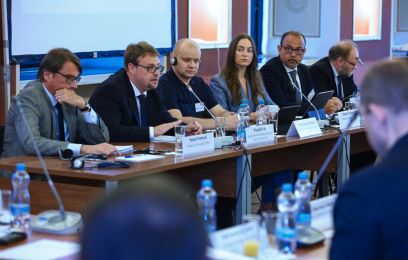
The faculty also included Veronika Bílková, Member of the Venice Commission and Head of the Department of International Law in the Faculty of Law of Charles University, and Robert Strang, Executive Director of the CEELI Institute. They took part in the panel discussion “Accountability Avenues for Atrocity Crimes and Other Violations of International Law in Ukraine.” Strang emphasized the importance of pursuing accountability through multiple legal systems, including the use of universal jurisdiction in other national courts:

“It sends a symbolically powerful message when another legal system recognizes that a violation has been committed,” highlighted Robert Strang.

Iryna Marchuk, Associate Professor at the Copenhagen University Faculty of Law, and a returning Summer School faculty member, shared how she was impressed by the students' resilience, passion, and commitment to international law and accountability amid the ongoing war. She emphasized why introducing these subjects early in a lawyer’s career matters and explained that she had not studied war crimes while at law school; only after entering the human rights sector did she encounter these issues and was left to learn about them in practice.

Providing students with that knowledge before they face similar challenges professionally can therefore give them an important foundation for supporting victims, documenting violations, and contributing to future accountability efforts.

Building a Professional Community

The Summer School is not only an intense learning experience that equips young lawyers with invaluable knowledge, but it also connects like-minded and hard-working future young Ukrainian professionals and builds networks with peers and long-time professionals in their field.

Participants frequently highlighted the value of meeting and interacting directly with the outstanding faculty. For some, those conversations reshaped their perception of what a career in law could look like and helped them imagine new possibilities for their own professional futures.

Those connections are an important part of the program. As Dmytro Koval writes after returning for his third year as a faculty member, “Over the years, the school has become an important hub for the growth of young professionals, as well as a place where experts and participants establish connections that lead to interesting professional engagements.”  He noted that at Truth Hounds alone, 7 Ukrainian Summer School alumni have joined his organization and are documenting war atrocities.

CEELI Institute is thus very proud to welcome this year’s 32 participants into a growing alumni network of more than 120 graduates.

The Work Ahead

The challenge of achieving justice for violations committed in Ukraine will not disappear. It will require prepared lawyers who can understand the available avenues for accountability, identify the strengths and limitations of different legal mechanisms, document violations carefully, build persuasive arguments, and communicate the facts to courts and the international community.

It will also require sustained attention. The lesson behind Judith Ritter’s mock trial advice therefore extends well beyond a mock trial. Guiding attention to what matters most is not only a skill for an individual advocate addressing a court but an important part of the broader work of ensuring that evidence is heard, violations are recognized, and the pursuit of justice continues.

The path toward accountability is complex and will take time. Each new cohort leaves the Ukrainian Summer School with stronger skills, wider professional networks, and a clearer understanding of the role they can play in the work ahead.

Related reading

Keep up with all things CEELI

Subscribe to the Newsletter